Why Is My Domain Renewal So Expensive? (And How to Avoid the Trap)
That cheap domain you bought for $1 just renewed for $25. Here's why domain renewals cost so much more than the first year — and how to avoid overpaying.
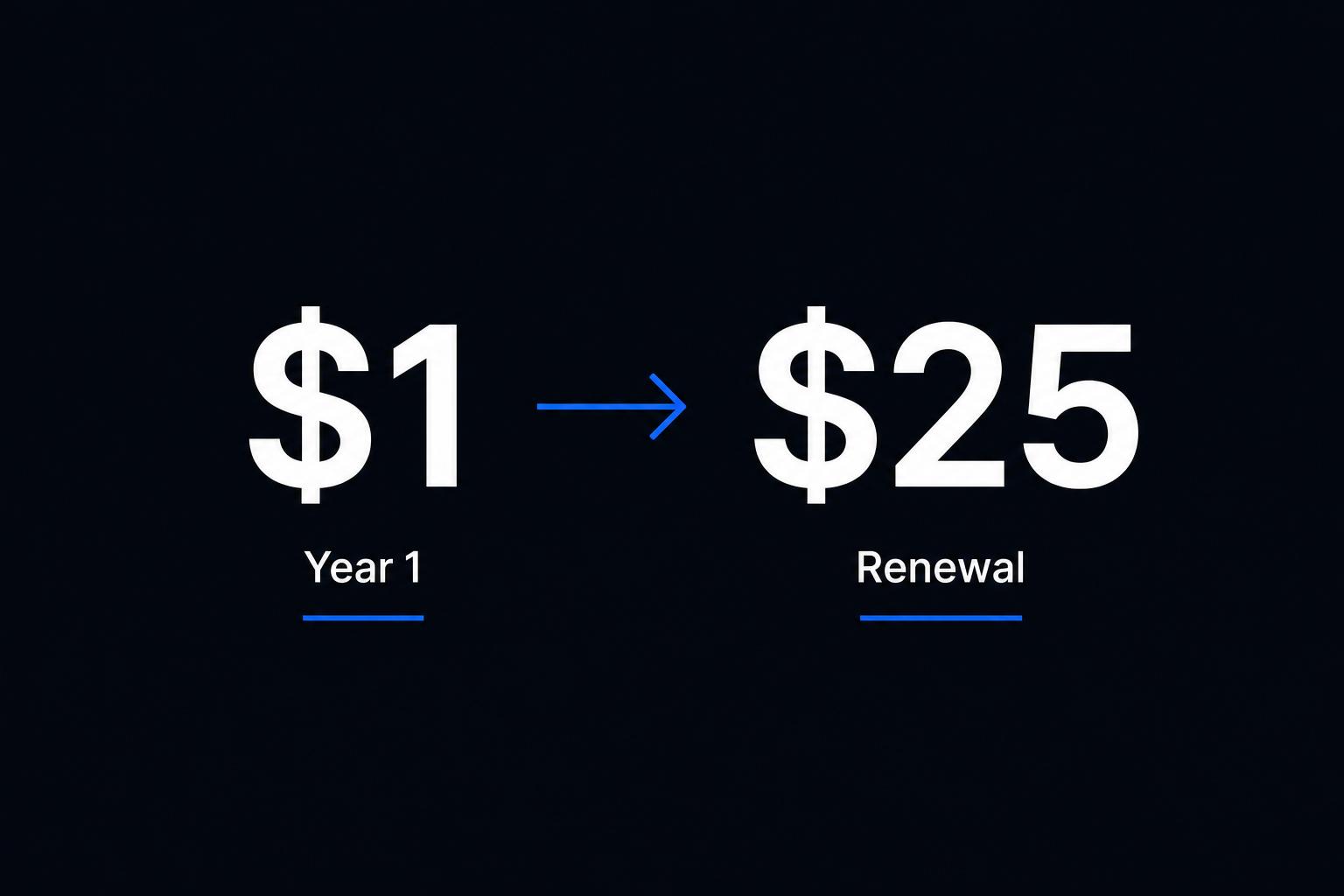
So you grabbed a domain for a dollar last year, felt clever about it, and then the renewal notice landed: twenty-five dollars. Maybe more. If you've ever stared at that email wondering what happened, you're not alone — and no, you didn't do anything wrong. This is just how a lot of the domain industry works, and once you understand it, you'll never get caught out again.
The first-year price is bait
Here's the uncomfortable truth: that first-year price you saw advertised was a hook. Registrars know that getting you in the door is the hard part. Once your domain, your website, and your email are all tied to one company, you're unlikely to move — switching feels like a hassle, even when it isn't. So they offer a tiny introductory price to win your signup, then quietly raise the price every year after.
A domain that costs $0.99 to register might renew at $18, $22, or even more. The registrar isn't doing anything illegal — the renewal price is usually listed somewhere in the fine print — but almost nobody reads it at checkout. You're focused on getting your idea online, not scrolling through a pricing table.
Why the gap is so big
Behind every domain is a wholesale cost the registrar pays to the registry (the organisation that runs the extension, like .com or .io). That wholesale cost barely changes. So when a registrar sells you the first year below cost, they're taking a small loss to win you — and they make it back, with interest, on every renewal for as long as you stay.
Some extensions are worse than others for this. The trendy ones — .io, .ai, .co, .tech — often have high wholesale costs to begin with, so both the first year and the renewal sting. The classic .com is usually the most stable and predictable over time, which is one reason it's still the safest long-term choice for most people.
How to actually avoid overpaying
The fix is simple: stop looking at the first-year price and start looking at what the domain costs every year after. A domain you'll keep for five years is really a five-year purchase, not a one-year one. A registrar charging $1 the first year and $25 after is far more expensive over time than one charging $10 flat — but the cheap-first-year offer looks better at a glance.
This is exactly why we built MyDomainCost to show you three numbers for every registrar: the first-year price, the renewal price, and the real five-year total. When you sort by five-year total, the rankings often flip completely — the "cheapest" option suddenly isn't.
A few practical tips
If you're buying a domain you intend to keep, check the renewal price before you commit, not after. If you already own a domain that's renewing at a painful price, remember you can usually transfer it to a cheaper registrar — transfers often include an extra year at the new registrar's rate, so you're not losing time. And if you're choosing between extensions, factor the long-term renewal into the decision, not just the launch-day discount.
The domain itself doesn't change based on where you buy it. A .com is a .com whether you pay $9 or $20 a year for it. The only thing that changes is how much you hand over — so it's worth thirty seconds to check.
Want to see the real five-year cost of a domain across every major registrar? Search it on MyDomainCost and sort by five-year total.
Compare a domain →